

Beyond the Label
Why Hopeful Haven isn't certified organic — and what we do instead
The question we hear most at the stand is a good one: "Are you organic?"
The honest answer is no — and we'd like to tell you why, because the why is the whole story of this farm.
What "organic" actually means
Organic certification is a list of inputs. It tells you what a farm is not allowed to buy — synthetic fertilizers, most manufactured pesticides, GMO seed. That list did real good when it was written, and plenty of organic farms are run by people who care deeply. We're not here to knock anyone's certificate.
But here's what surprised us when we studied the rules: organic farms can still spray. The organic-approved list includes copper sulfate, which builds up in soil and is toxic to earthworms and pond life. It includes pyrethrins and spinosad — broad-spectrum insecticides that don't check whether the insect they land on is a pest, a honeybee, or a firefly. A certified organic farm can use these routinely and keep its seal.
And here's what the certificate never asks: Is the soil more alive this year than last? Is the water cleaner? Did the birds come back? Are there more fireflies in June than there were before?
Those are the only questions we actually care about.
What we do instead
We farm the way land heals. Some call it regenerative. We call it paying attention.
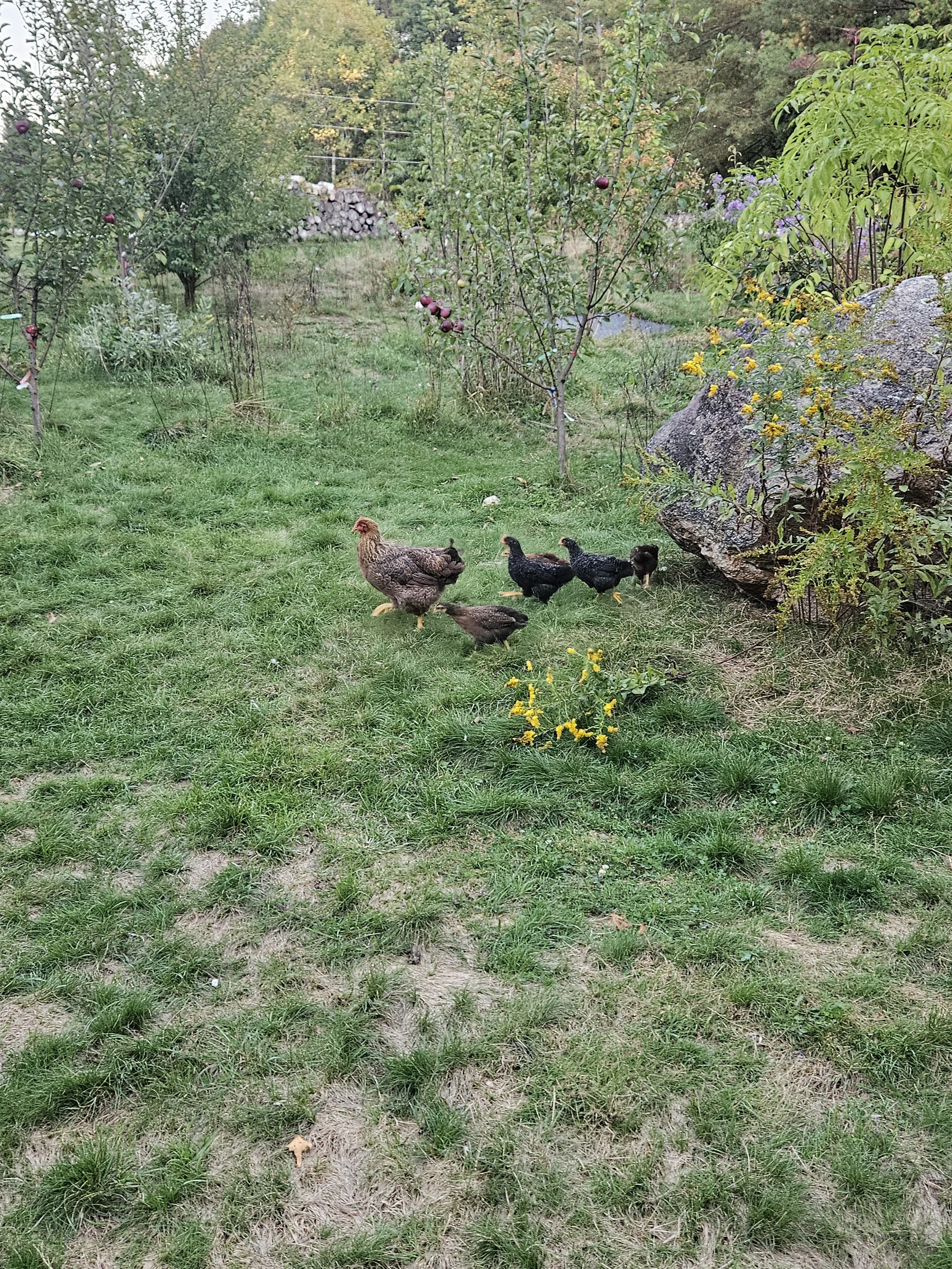
No sprays. No shortcuts. No synthetic pesticides, herbicides, or chemical fertilizers — and none of the organic-approved sprays either. Our pest control is habitat itself: songbirds, predatory insects, toads, and a very motivated flock. When you don't kill the helpers, the helpers do the work.
Pasture, not a pop-out door. Our chickens and ducks range every day of the year — orchard, gardens, field edges, pond. In winter they choose to stay closer to home and make a great deal of mud, but the gate is always open. You may have seen "free range" on cartons; legally, that only means the birds had access to the outdoors. A small door onto a dirt strip qualifies. Pasture-raised is a different life: real ground, real plants, real bugs, every day. Free range means the door was open. Pasture-raised means they were actually out there — ask Lily and Daisy, our guardian dogs, who keep watch so the flock can roam.
Soy-free feed our soy-sensitive neighbors count on. When the flock isn't foraging, they eat a soy-free, non-GMO ration. Soy proteins pass into eggs, so for the people who need soy-free eggs, this is the difference. We priced organic feed and made a different choice: that money goes into habitat instead.
The flock builds the soil. After harvest, the birds turn our garden beds — cycling nutrients, clearing overwintering pests, doing tractor work on two legs. Nothing here is wasted, and nothing is forced.
A yolk color you can trust. A deep orange yolk is supposed to mean pasture. It can also be bought: marigold extract and paprika are legal feed colorants, allowed even in organic rations, and they dye yolks in birds that never saw grass. Our yolks get their color from clover, bugs, and weeds. Come watch them earn it.
Ugly is fine. Alive is the point. Our eggs come unwashed with the bloom on, and some of them come from under the firewood pile. Our produce won't always win a beauty contest — cosmetic grading has nothing to do with nutrition. What matters is soil that's biologically alive, because richer soil grows richer food.
Same rules for our partners. When another farm or a neighbor shares our stand, they follow the same practices we do, or they don't share the stand. That matters to us more than the sale.
The land tells the truth
This farm sits on a former sand and gravel pit. The federal soil survey classifies our ground as land with "little or no soil material" that supports "little or no vegetation."
That's our starting line. Today, this same ground is a flowering orchard, working gardens, a living pond, and documented habitat for hundreds of species — pollinators, fireflies, songbirds, native turtles, and orchids that can only grow where the underground fungal network has quietly rebuilt itself. You can't fake that. Fungi don't read marketing.
We didn't certify our inputs. We let the land certify our outcomes.
This land is a CERTIFIED Bee Friendly Farm® by Pollinator Partnership. It is also an NWF Certified Wildlife Habitat, a Monarch Waystation, a Certified Firefly Habitat, Xerces Pollinator Habitat and Pesticide-Free, a UNH Pollinator-Friendly Garden, a Million Pollinator Garden Challenge garden, a BFG Registered Garden, and a NABA Certified Butterfly and Monarch Garden, kept by a Certified Pollinator Steward.
Twelve independent programs have reviewed and certified this land. That's our label.
Honesty, always
Every egg at our stand comes from this certified habitat. The raw honey at the stand is local, from hives we trust, and we'll tell you exactly whose if you ask. Honey is never for infants under 12 months — sticks and candy included.
Come see for yourself
Everything on this page is something you can see with your own eyes. Walk the fence line. Look at the yolks. Count the fireflies in June. Ask us anything — the gate's the whole point.
Hopeful Haven Homestead · 12 Laliberte Ln, Candia, NH 03034 · 603-231-6389 · Contact@HopefulHavenHomestead.com · @hopefulhavenhomestead