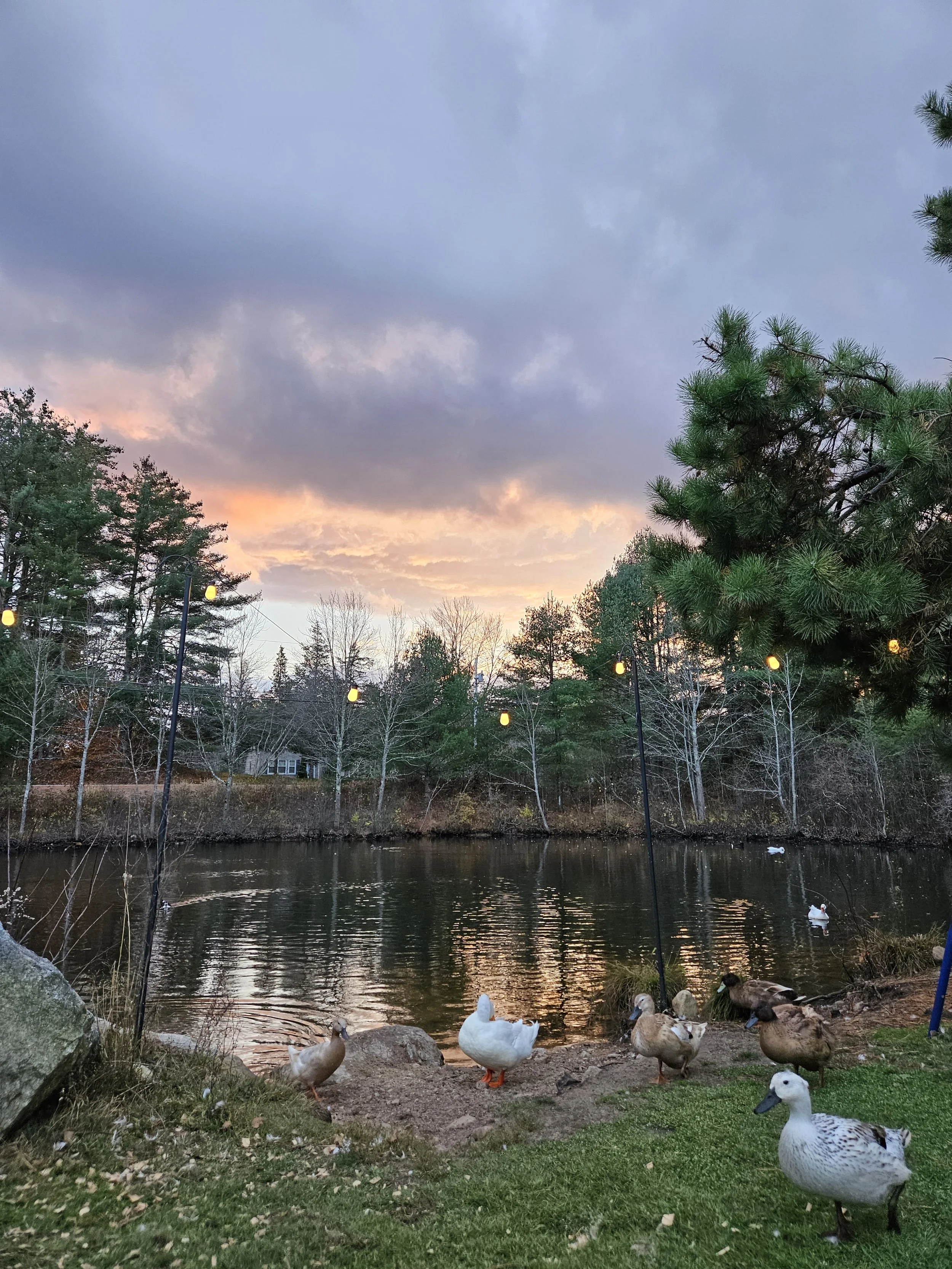
We Don’t Just Grow Food. We Build Habitat.
The Philosophy: A Wildlife Fortress We believe that a farm shouldn’t fight nature—it should fuel it. Located in Candia, NH, Hopeful Haven Homestead is managed as a "Wildlife Fortress." Julie is a Certified Pollinator Steward, and every decision we make—from "No-Mow" zones to leaving leaves for overwintering insects—is designed to support the local ecosystem. When you buy eggs or produce from us, you aren't just feeding your family; you are funding a sanctuary for native bees, birds, and soil life.

Our Promise Transparency is our currency. We believe you should know your farmer. If you have a question about how we treat our animals or what we feed our soil, just ask. We are building this homestead for the long haul, one fence post and one planting season at a time.

The People: Julie & Michael We are a family-run operation. There is no corporate staff here—just us, our kids, and the animals. We balance this homestead with our "day jobs" in technology and construction, which means our mornings start early and our boots are usually muddy. We built this life because we wanted to know exactly where our food came from, and we wanted to share that security and quality with our neighbors.


The Method: Better Than Organic We don't hide behind labels; we stand behind our practices. Our poultry is pasture-raised, meaning they live their lives outside, scratching in the dirt and hunting bugs, just as nature intended. We use sustainable, chemical-free methods for our gardens, prioritizing soil health over synthetic shortcuts. It’s harder work, but you can taste the difference in the yolk of the egg and the snap of the bean.
What the Land Holds
This farm sits on a former sand and gravel pit — ground the federal soil survey classifies as having "little or no soil material." We didn't certify our inputs; we let the land certify our outcomes. Independent programs have reviewed and certified this land as habitat:
This land is a CERTIFIED Bee Friendly Farm® by Pollinator Partnership.
NWF Certified Wildlife Habitat · Monarch Waystation · Certified Firefly Habitat · Xerces Pollinator Habitat · Xerces Pesticide-Free · Certified Pollinator Steward · UNH Pollinator-Friendly Garden · Million Pollinator Garden Challenge · BFG Registered Garden · NABA Certified Butterfly Garden · NABA Certified Monarch Garden
The Stewardship Record
We keep a written Ecology & Stewardship Profile of this property — hundreds of pages, hundreds of species. Every entry is a photograph or a dated observation, scored for how confident we are, and checked against published sources before it goes in. Pollinators, fireflies, songbirds, otters, native turtles (two state-listed species nest here — we don't say which, for their sake), and the fungi and orchids that only return when the soil underneath has come back to life. We share the public edition with anyone who asks, and we use it to teach. Stewardship isn't a slogan here; it's a document we keep updating.
The Herbalist
Julie is a Certified Herbalist. The herbs that grow here — in the beds, along the pond, and in the field edges — are catalogued in The Hopeful Haven Herbal, fifty plants from this land, each one graded for what the published evidence actually supports. Education first, always: we would rather you know a plant than buy one.
AI on the Farm
Our day jobs are in technology, and we use AI here the way our grandparents used a ledger — only the ledger talks back. It catalogs the thousands of photos and security-camera clips the farm produces, drafts and checks the stewardship profile, cross-references every species sighting against the scientific record, keeps our standard operating procedures, and runs the farm's records. The rules never change: the AI drafts, we verify. Every identification carries a confidence score. Species counts come from the data, never from memory. And no machine will ever tell you a wild mushroom is safe to eat. It lets two people with muddy boots keep the kind of records a research station would — and that is how a gravel pit gets a 250-page biography.